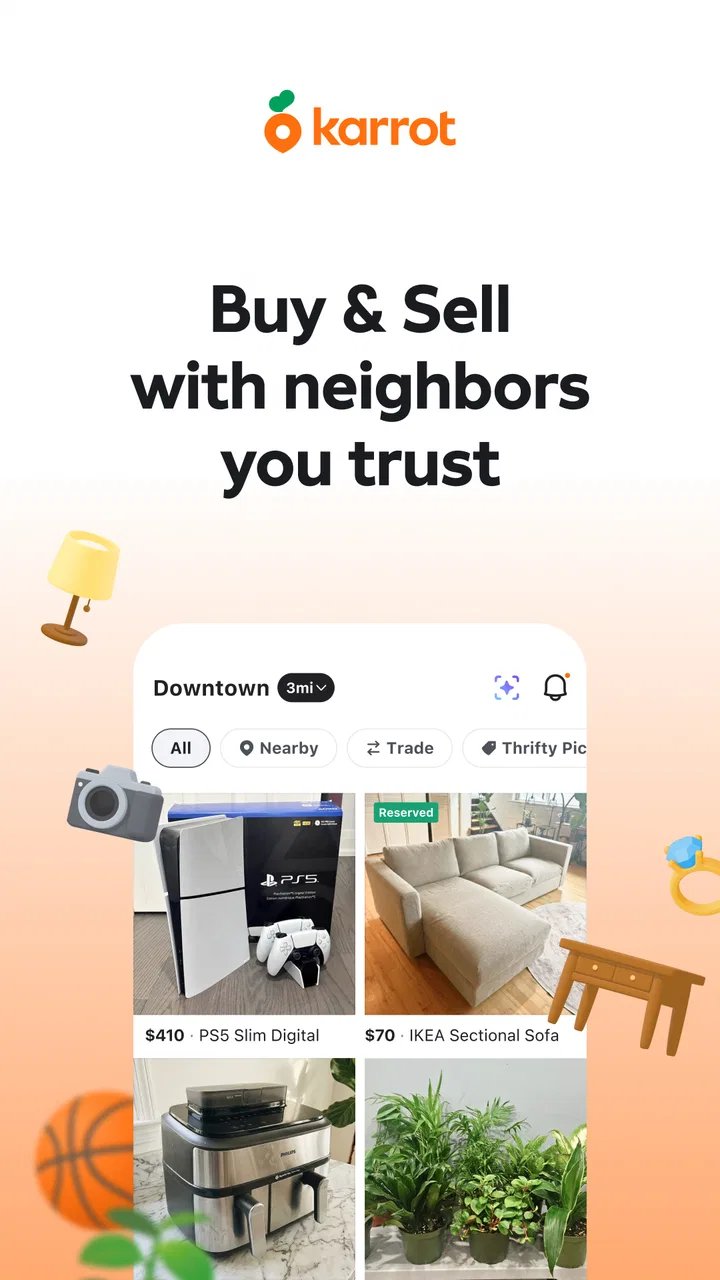
Karrot: Buy & sell locally
- 4.2
- Rating
- 10.00M
- Installs
- Free
- Price

 Analysis by App-foxy
I like local marketplaces because they solve a very ordinary problem: getting useful things out of a cupboard and into the hands of someone nearby. Karrot: Buy & sell locally takes that idea and makes it feel more neighborhood-focused than a broad national classifieds service. I can browse nearby listings, judge whether a pickup is practical, and message a seller without turning a simple sale into a shipping project. That local emphasis is the reason I would recommend it to a friend who wants to clear out household items or find affordable preloved goods.
It is a free social app from Danggeun Market Inc., and its audience is clearly substantial: the Android listing shows over ten million installs and an average score of 4.2 from around 187 thousand ratings. Those figures do not replace personal experience, but they do suggest that the app has moved beyond being a niche experiment. I found the most value in treating it as a practical community noticeboard rather than as an endless shopping catalog.
How Karrot feels during everyday browsing
The first thing I noticed is that the local model changes how I browse. On a conventional marketplace, I often start with a product search and then worry about delivery, seller distance, and whether the item is worth the total cost. Here, proximity is part of the decision from the beginning. A used chair, lamp, bicycle, or small appliance becomes more appealing when collection is realistic, while a bargain several neighborhoods away may stop being a bargain once travel time is considered.
You May Also Like

 Blood Strike: 2.5 Anniversary
Blood Strike’s Loadouts Turn Every Drop Into a Tactical Gamble
A close look at Blood Strike’s custom loadouts: how fast access to signature weapons reshapes its battle royale rhythm, rewards preparation, and narrows the gap between fights.

 Pandora - Music & Podcasts
Pandora’s Music Is Easy to Start, but Harder to Recover
Pandora’s strength is its low-effort path from a seed to a station. Its weak spot is how much confidence it asks you to place in connection, setup, and quiet recovery.

 8 Ball Pool
 Is Built on Rivalries, Rematches, and Routine
A close look at the rivalries, rematches, shared routines, and unanswered safety questions that turn a quick pool match into a persistent mobile community.

 Samsung Music
’s Quiet Strength Is Playing What You Already Own
Its reach comes less from spectacle than from dependable access to a personal library. That simplicity is both the app’s strongest retention engine and its ceiling.

 AccuWeather: Weather Radar
AccuWeather Review: A Quick, Clear Forecast for Everyday Decisions
For everyday plans, the best forecast is the one you can understand quickly. AccuWeather makes rain timing, radar, and local conditions easy to act on, with a few trade-offs.

 Hill Climb Racing
Why Hill Climb Racing Still Turns Crashes Into One More Run
A tiny car, a bumpy hill and one more upgrade: Hill Climb Racing keeps resurfacing because its simple chaos makes every near-miss feel personal.
More From Our News Desk



That focus also affects perceived speed. Listings that match my area are easier to evaluate quickly because I am not sorting through offers that would require complicated shipping. The app itself opens and responds like a normal modern social application on a compatible phone, but the useful speed is really the speed of making a decision. A clear photo, a sensible description, and a nearby location can tell me within moments whether I should contact the seller.
I would not confuse fast browsing with instant transactions. The app can help me discover an item and start a conversation, but the seller still has to answer, the condition still needs checking, and a pickup still needs arranging. That is an important distinction for anyone expecting the frictionless checkout of a retail store. Karrot is closer to a focused local conversation than to a one-tap shopping service.
Why the local context matters more than a large catalog
In my experience, the strongest listings are the ones where distance and condition are easy to understand. A seller who explains a scratch, includes useful photos, and gives a realistic pickup window saves both sides time. As a buyer, I can ask a short question before making a trip. As a seller, I can write with the assumption that the other person may collect the item rather than wait for packaging and delivery.
This makes the app especially useful for bulky or awkward things. Furniture, storage boxes, children’s equipment, and home accessories are often inconvenient to ship through a general resale platform. A local handoff can be simpler and cheaper. It is also practical when I need something quickly and would rather collect it today than wait for a parcel.
The trade-off is selection. A large national marketplace may offer more versions of a specific product, while the nearby feed can be narrower and more dependent on what people in my area are clearing out. If I need an exact model, a rare part, or a guaranteed purchase, I would probably look elsewhere first. Karrot works best when I am flexible about brand, color, or precise specification.
A realistic use case: clearing a room without creating a shipping job
Imagine I am moving a desk, a floor lamp, and several kitchen items out of a spare room. I can photograph each item in good light, describe its wear honestly, and set a pickup expectation that suits my schedule. A nearby buyer may be willing to collect the desk because the distance is manageable. The lamp can go to someone who wants an inexpensive local find, while the smaller items may attract people who are already checking the neighborhood feed.
The useful workflow is to prepare before posting. I would measure furniture, note stairs or elevator access, decide whether help is needed, and state what the buyer must bring. That prevents the common problem of agreeing on a price only to discover that the item cannot fit in the buyer’s car. Local selling is not automatically effortless; it simply moves the main work from shipping to clear communication and handoff planning.
For buyers, I would save time by deciding my maximum travel distance before browsing. A low price can be misleading if it requires a long round trip or special transport. I would also ask the questions that affect the decision most: dimensions, age, working condition, included accessories, and pickup timing. These small habits make the app feel faster because they reduce unnecessary conversations and wasted journeys.
Performance during heavier use
Light browsing is not the only test. When I use a local marketplace repeatedly, I may move between many listings, open several photo sets, switch into messages, return to the feed, and check new items later. That kind of session is more demanding than opening the app once to inspect a single offer. The experience remains most comfortable when I keep my search focused instead of treating the feed like an infinite shopping mall.
Photo-heavy browsing naturally asks more from a phone and a connection than reading plain text. If I am comparing several furniture listings or checking detailed images for damage, loading time can feel more noticeable than it does during a quick scroll. That is not a special flaw unique to this service; it is a consequence of the way second-hand buying depends on visual evidence. I would rather wait briefly for useful photos than make a decision from a vague description.
Messaging can also create a heavy-use moment, especially when several sellers respond around the same time. I recommend keeping each conversation organized around one item and confirming the agreed details before leaving the chat. A short written summary of the price, meeting arrangement, and timing is more reliable than assuming both people remember the same conversation later.
One non-obvious advantage of the local format is that it can reduce mental load even when the feed is busy. I do not need to calculate shipping for every listing or compare distant sellers with different delivery conditions. The app narrows the practical question to something I can answer: is this item worth collecting from this person in this area? That is a meaningful performance benefit for decision-making, even though it is not a technical benchmark.
Where friction appears in real use
The biggest slowdown is often human rather than technical. A listing may look perfect but have incomplete information. A seller may reply later, change their mind, or discover that another buyer is collecting first. A buyer may ask for a discount without recognizing the effort involved in moving a large item. No local marketplace can remove those uncertainties completely.
I also find that local availability can change quickly. If I wait too long on an attractive listing, it may no longer be relevant. That creates a different rhythm from ordinary online shopping: I need to act decisively when the item suits me, while still asking enough questions to avoid a bad purchase. The right balance is not “buy immediately”; it is “verify the important details before someone else takes it.”
For sellers, repeated posting can become tiring if every item needs separate photos and messages. I would group similar household items only when the description stays clear, rather than creating a confusing bundle that nobody understands. For buyers, repeated low-quality listings can make browsing feel less efficient. In both cases, careful wording improves the experience more than simply spending more time scrolling.
Reliability, trust, and recovering from problems
Reliability in a community marketplace has two layers. The application needs to remain usable, but the people and listings also need to be dependable. My practical advice is to judge both separately. A smooth interface does not make an unclear listing trustworthy, and a well-written listing cannot help if communication breaks down.
I look for consistency between the photos and the description, specific answers to questions, and a realistic arrangement for collection. If someone avoids basic questions about condition or keeps changing the meeting details, I would walk away. The local setting can make a transaction feel more personal, but it should not replace ordinary caution.
Recovery matters when a deal does not go as planned. If a buyer cancels, a seller should be ready to update the listing rather than assuming the first agreement is final. If an item is materially different from its description, the buyer should explain the issue promptly and keep the conversation factual. I would avoid handing over money before I have inspected an item, particularly for electronics, appliances, or anything with hidden wear.
That advice is not meant to make the app sound unsafe. It is simply the correct mindset for peer-to-peer selling. Karrot is useful because it connects nearby people, and that same person-to-person structure means I remain responsible for checking condition, confirming logistics, and deciding whether a deal feels sensible.
Another practical recovery habit is to keep a backup plan. If I am buying a large item, I would not arrange a van or recruit help until the seller confirms the appointment. If I am selling something before moving house, I would leave enough time for a missed pickup. Local convenience is strongest when I build a little flexibility around it instead of assuming every arrangement will happen exactly as planned.
Who should use it, and who should skip it?
I think Karrot is a strong fit for people who want to sell unwanted household goods without packing and shipping them. It is also useful for buyers who enjoy finding practical bargains nearby, can collect items themselves, and are comfortable asking questions about used condition. Renters furnishing a room, families replacing children’s equipment, and people decluttering after a move may get more value from it than someone searching for a brand-new product.
I would skip it when I need guaranteed stock, formal returns, professional delivery, or a precise product specification. A retailer is better for a new appliance with warranty support. A specialist marketplace may be better for collectibles, replacement parts, or enthusiast equipment where authenticity and technical detail matter more than proximity. A shipping-focused resale platform can also be preferable when the right buyer is unlikely to live nearby.
The app carries a Teen content rating, so I would still apply sensible judgment about meetings and communication, especially for younger users. A public collection point, an adult’s awareness, and a clear daytime arrangement are reasonable precautions. The local nature of a transaction should make collection easier, not encourage anyone to ignore personal safety.
Device limits and practical expectations
The Android version requires Android 8.0 or later, which covers many still-used phones but excludes older devices. On a phone that meets that requirement, the experience will depend on more than the app alone: available storage, memory pressure, connection quality, and how many other applications are active can all affect scrolling and image loading. I would keep the phone reasonably maintained if I planned to browse photo-heavy listings often.
Resource demands are likely to be felt most during long sessions with many images and active conversations, rather than during a brief check of one listing. If my phone is older or already struggling with other social apps, I would expect more pauses when moving rapidly through photos. That does not make the app unusable, but it does make selective browsing a better habit than leaving every possible search open at once.
Battery use also depends on how I use it. A quick message and a short feed check are modest tasks, while extended browsing with frequent photo loading naturally keeps the screen and connection active. I would not judge the app by a single long session on a busy day, but I would notice whether it remains comfortable for the way I actually shop. For me, the local relevance makes shorter, more purposeful sessions realistic.
The current version is 26.9.0, and keeping an app like this updated is worthwhile because marketplace reliability depends on current messaging, listing, and account behavior. I would install it only on a compatible operating system and allow enough free space for ordinary app updates and cached images. These are simple maintenance steps, but they help avoid blaming the marketplace for problems caused by a crowded or outdated device.
There is also a social constraint that no phone specification solves: the quality of a local feed depends on the activity around me. In a busy area, I may see fresh offers and have several options. In a quieter area, the app may feel slower simply because fewer suitable items are available. That is not a loading failure; it is the natural limit of a neighborhood-based service.
My final view after using it as a local marketplace
I see Karrot as a focused tool for practical exchanges, not a universal replacement for every shopping platform. Its best quality is the way it turns distance into useful context. Instead of asking only whether an item is cheap, I can ask whether it is close enough, convenient enough, and worth the effort of collecting. That makes the service particularly convincing for furniture, household goods, and everyday items where shipping would add unnecessary complexity.
The experience is most rewarding when I write and read listings carefully. Good photos, honest condition notes, measurements, and a confirmed pickup plan matter more than clever searching. My three strongest tips are to set a realistic travel limit, inspect important items before payment, and summarize the final arrangement in writing. Those habits protect time on both sides and make the app feel considerably more dependable.
I also appreciate that it is free to use, because that lowers the barrier to experimenting with a first listing or checking whether a nearby bargain exists. The Teen rating is a reminder to treat local meetups responsibly, while the broad adoption reflected in its store presence makes it easier to imagine finding an active audience. Still, popularity cannot guarantee that every neighborhood or category will be equally lively.
My recommendation is straightforward: choose this app if you value nearby pickup, flexible second-hand shopping, and direct communication with local people. Choose a retailer or a shipping-centered marketplace if you need certainty, warranties, delivery, or a very specific item. For the right situation, the real strength is not simply buying used goods; it is reducing the distance between a spare item and someone who can use it. That is a modest idea, but in everyday life it can save money, time, and a surprising amount of hassle.
After considering its speed expectations, heavier browsing moments, reliability, and device requirements, I would keep it installed for occasional local searches and decluttering projects. It does not eliminate the judgment that second-hand transactions require, and it cannot make every seller responsive. What it does well is give local buying and selling a clear, approachable place to happen. For me, that makes Karrot: Buy & sell locally a worthwhile social app when convenience means meeting nearby rather than receiving another package.
FAQs for Karrot: Buy & sell locally
01What is Karrot and how does it work?
Karrot is a community-based marketplace app that allows users to buy and sell items locally. It connects you with neighbors to trade goods without the hassle of shipping. Users can list items for sale, browse listings, and chat directly with sellers to arrange meetings and transactions.
02Is Karrot free to use?
Yes, Karrot is free to download and use. There are no listing fees or hidden charges. However, users should be aware of potential transaction costs, such as payment methods or delivery fees, if any, which should be discussed directly between the buyer and seller.
03How safe is it to use Karrot for buying and selling?
Karrot emphasizes community trust and safety by allowing users to rate each other and leave reviews after transactions. It’s advisable to meet in public places and follow safety guidelines provided by the app. While Karrot provides a platform, users are responsible for ensuring their own safety during exchanges.
04What types of items can be sold on Karrot?
Karrot supports the sale of a wide range of items, from electronics and clothing to furniture and books. However, prohibited items include illegal goods, weapons, and counterfeit products. Users should ensure their listings comply with Karrot’s community guidelines to avoid removal of their posts.
05How do I contact customer support if I encounter issues?
If you experience any issues with the app or a transaction, Karrot offers customer support through its help center within the app. Users can access FAQs, submit inquiries, and report issues directly. Prompt responses and community feedback are part of the support process to resolve concerns efficiently.
Pros
- Easy-to-use interface for quick navigation.
- Secure transactions with verified users.
- Localized listings for nearby bargains.
- In-app chat for seamless communication.
- No listing fees for selling items.
Cons
- Limited to specific regions and cities.
- No buyer protection or guarantees.
- Occasional spam listings.
- Limited payment options available.
- Requires location access for full features.

Karrot: Buy & sell locally
Gallery